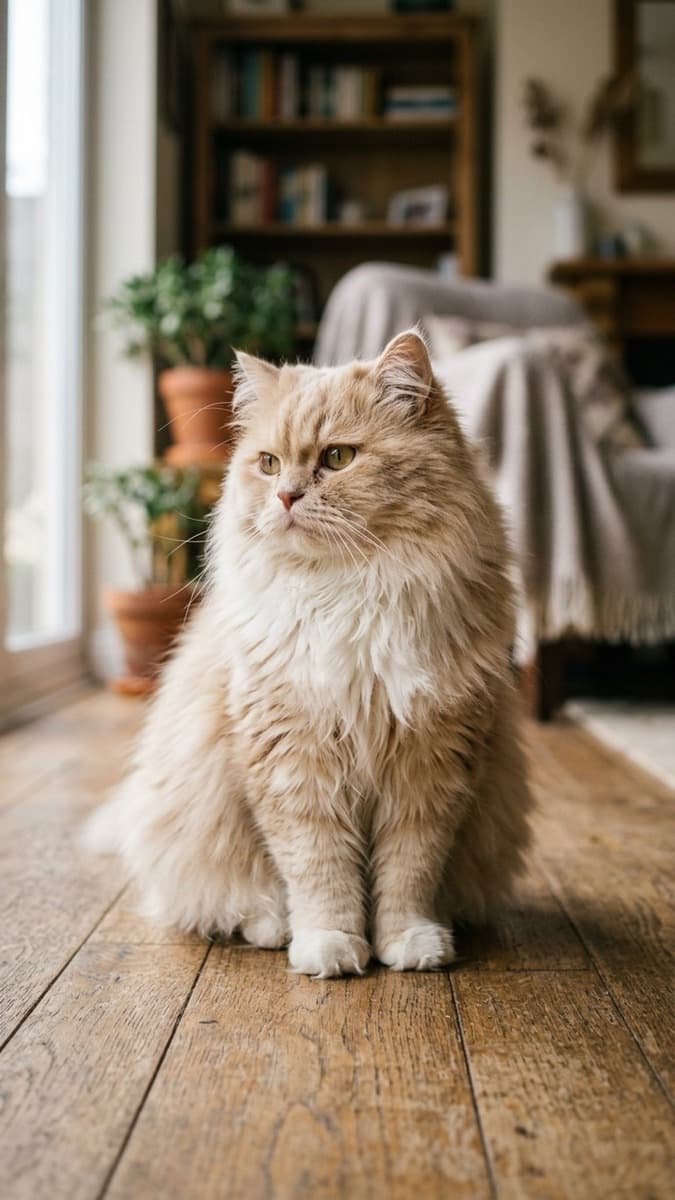
The Persian weighs between 3 kg and 5.5 kg, has low energy and a flat face — the breed's brachycephalic conformation. That makes it hard to eat small, round kibble. Add to it a predisposition to polycystic kidney disease and a tendency to form hairballs because of the long coat. Adapted kibble shape, controlled phosphorus and functional fiber are the priorities in this breed's food.
Na análise atual da Revista Pet, a melhor ração para Persa é Fórmula Natural Fresh Meat (Adimax), com nota técnica 85.8/100 (🌟 Qualidade Superior), calculada pela metodologia IDNM/IPFI Revista Pet sobre 55 rações para gatos analisadas em julho de 2026. Ver o ranking completo ↓
O que considerar na ração para Persa
Three things weigh most in a Persian's food: kibble shape, controlled phosphorus and functional fiber.
Flat face. The Persian's short muzzle makes it hard to pick up ordinary kibble shapes. Larger kibble, with a geometry designed for that face, makes biting and chewing easier — the cat wastes less food and eats with less effort.
Kidney. The breed has a documented predisposition to polycystic kidney disease, a genetic mutation that already appears with considerable frequency in Persians. Food does not cure that — but controlled phosphorus works as preventive support for the kidney, and is worthwhile even without a confirmed diagnosis.
Hairballs. A long coat sheds more hair, and the cat ends up swallowing a good deal of it while grooming. That increases the risk of hairballs (trichobezoars). Insoluble fiber in the food helps that hair pass through the intestine instead of getting stuck.
Critérios avaliados pelos targets nutricionais Revista Pet (faixas de proteína, gordura, cálcio e densidade calórica por porte — ver metodologia).
Perfil e predisposições da raça
The Persian has a well-documented brachycephalic facial conformation. A study published in the Journal of Feline Medicine and Surgery (Anagrius et al., 2021) found a prevalence of moderate to severe stenotic nares in 86% of the Persian and Exotic Shorthair cats assessed, as well as epiphora in 83% of cases — findings absent in the control group of mixed-breed cats. In practice, that calls for an adapted kibble shape, which makes it easier for a flat face to pick up the food.
The breed is also predisposed to polycystic kidney disease (PKD), an autosomal dominant inherited condition. According to the Merck Veterinary Manual — Congenital and Inherited Disorders of the Urinary System of Cats, the condition can be inherited in Persian cats and domestic longhair cats, with the kidneys potentially enlarging through the formation of multiple cysts. Controlling the phosphorus content of the diet works as preventive support for kidney function.
Finally, the breed's long coat increases the formation of trichobezoars (hairballs), since the cat ingests more loose hair while self-grooming. According to the Merck Veterinary Manual — Managing Hairballs in Cats, some commercial cat diets are formulated specifically to help prevent hairball formation. In practice, that means functional fiber in the food, which helps carry ingested hair through the digestive tract.
Rações recomendadas para Persa
Ranking por nota técnica IDNM/IPFI entre 55 rações para gatos — sem curadoria manual de produto.
- 1
Fórmula Natural Fresh Meat · Adimax
85.8/100 - 2
Biofresh Adultos Castrados · Hercosul
84.9/100 - 3
N&D Prime · Farmina
84.4/100 - 4
Pro Plan Sterilized · Purina
83.8/100 - 5
N&D Ancestral Grain · Farmina
81.1/100
Perguntas frequentes sobre ração para Persa
- Why does the Persian need kibble with a different shape?
- The Persian's flat face — the brachycephalic conformation — makes it hard to pick up small, round kibble. A 2021 study in the Journal of Feline Medicine and Surgery found moderate to severe stenotic nares in 86% of the Persians and Exotic Shorthairs assessed. Larger kibble, shaped with that face in mind, makes biting easier and reduces the effort the cat puts into eating.
- Does polycystic kidney disease in the Persian have anything to do with the food?
- The cause is not the food — it is genetic, inherited. But the Merck Veterinary Manual shows that controlling phosphorus in the Persian's food works as preventive support for the kidney, because the breed carries that mutation with well-documented frequency.
- Why does the Persian form more hairballs than other cats?
- A long coat sheds more hair, and the Persian swallows a good deal of it while grooming. That increases the risk of a trichobezoar (the technical name for a hairball). Functional fiber in the food helps that hair move through the intestine instead of getting stuck — a measure that makes sense in any long-haired cat, and in the Persian especially.
- Does every Persian have polycystic kidney disease?
- No. It is a genetic mutation present in part of the breed, not in every individual — but documented well enough by the Merck Veterinary Manual to justify controlling phosphorus in the food as prevention, even without a confirmed diagnosis.
- Does the Persian's kibble shape change how much he eats per meal?
- Kibble that is hard to bite makes the cat waste food and take longer to eat. Larger kibble, with a geometry adapted to the breed's flat face, makes picking up and chewing easier — the cat eats better and with less effort.
Metodologia
The block of recommended foods on this page is ordered by Revista Pet's IDNM/IPFI technical methodology, which evaluates the nutritional density and ingredient purity of each product in the active dataset for the Persian's medium-size profile — with no manual curation or brand influence.
The score takes into account how well the food fits the parameters of the breed profile: functional fiber for hairball control and formulas compatible with preventive kidney support are factors that weigh in the ranking, recalculated whenever the product dataset is updated.
O ranking desta página é uma projeção do motor de score IDNM/IPFI da Revista Pet sobre o dataset de gatos, sem curadoria manual de produto. Ver detalhes da metodologia →
Quer uma recomendação personalizada para o seu Persa?